The Second Rain
THIS IS A WORK OF FICTION
The first rain came down on College Street like a municipal punishment.
It was four in the afternoon, the hour when Calcutta usually melts into tea, argument, and sweat. Tram wires trembled above the road. The bookstalls had put out their blue tarpaulin skins, and boys with rolled-up trousers were rescuing pyramids of exam guides from the pavement as if saving infants from a burning ward. A taxi stalled near the Medical College gate with its bonnet open and its driver standing beside it, looking personally betrayed by all machines, all clouds, and the British Empire.
Inside Bose Book Repair, below street level, Nirmal held a stitched copy of Vidyasagar’s collected essays against his chest and smelled the first drain-water entering the shop.
“Not again,” said Mr. Bose, who had said the same thing about every event since 1987.
The shop was three steps below the footpath and therefore had the dignity of an old man who knew exactly how he would die. In heavy rain, water came in politely at first, thin as gossip. Then it climbed.
“Lift the ledgers,” Nirmal said.
Mr. Bose looked at the rain outside. It had become a gray wall. People were already shouting. The tea stall opposite had vanished behind spray, leaving only the bright orange flame of the stove, small and stubborn, like civilization reduced to one cup of cha.
“My wife said close early,” Mr. Bose said.
“Your wife has been saying close early since Durga Puja.”
“She is a wise woman.”
“She married you.”
Mr. Bose made a wounded noise, but he lifted the ledgers.
Nirmal climbed onto the stool and pushed bundles to the higher shelves. His fingers moved with the neat speed of a man who had spent thirty years repairing other people’s broken spines while ignoring his own. He lived in a damp two-room flat near Amherst Street with his daughter, Piu, who was twenty-one, serious, unemployed, and furious in the way educated young people were furious now: quietly, efficiently, with certificates in plastic folders. She had an interview the next morning at a coaching center that paid less than shame but more than nothing.
In his shirt pocket, Nirmal carried the rent money. Eight thousand rupees, folded twice, wrapped in newspaper. He had not told Piu he had borrowed half from Mr. Bose. He had not told Mr. Bose the other half was for her new shoes.
Respectability in Calcutta had become a performance staged with borrowed props: one pressed shirt, one English-medium sentence, one unpaid bill hidden under the mattress.
Outside, a bus gave a long, drowning groan.
Then the water came in all at once.
It rolled over the steps, brown, thick, carrying a lemon, two cigarette packets, a slipper, a drowned rat, and a garland of marigold flowers blackened by the drain. Mr. Bose swore. Nirmal jumped down. The water slapped his ankles, then his shins. It was warm.
Above the roar, someone screamed from the street, “Cloudburst! Cloudburst!”
As if giving it a name improved matters.
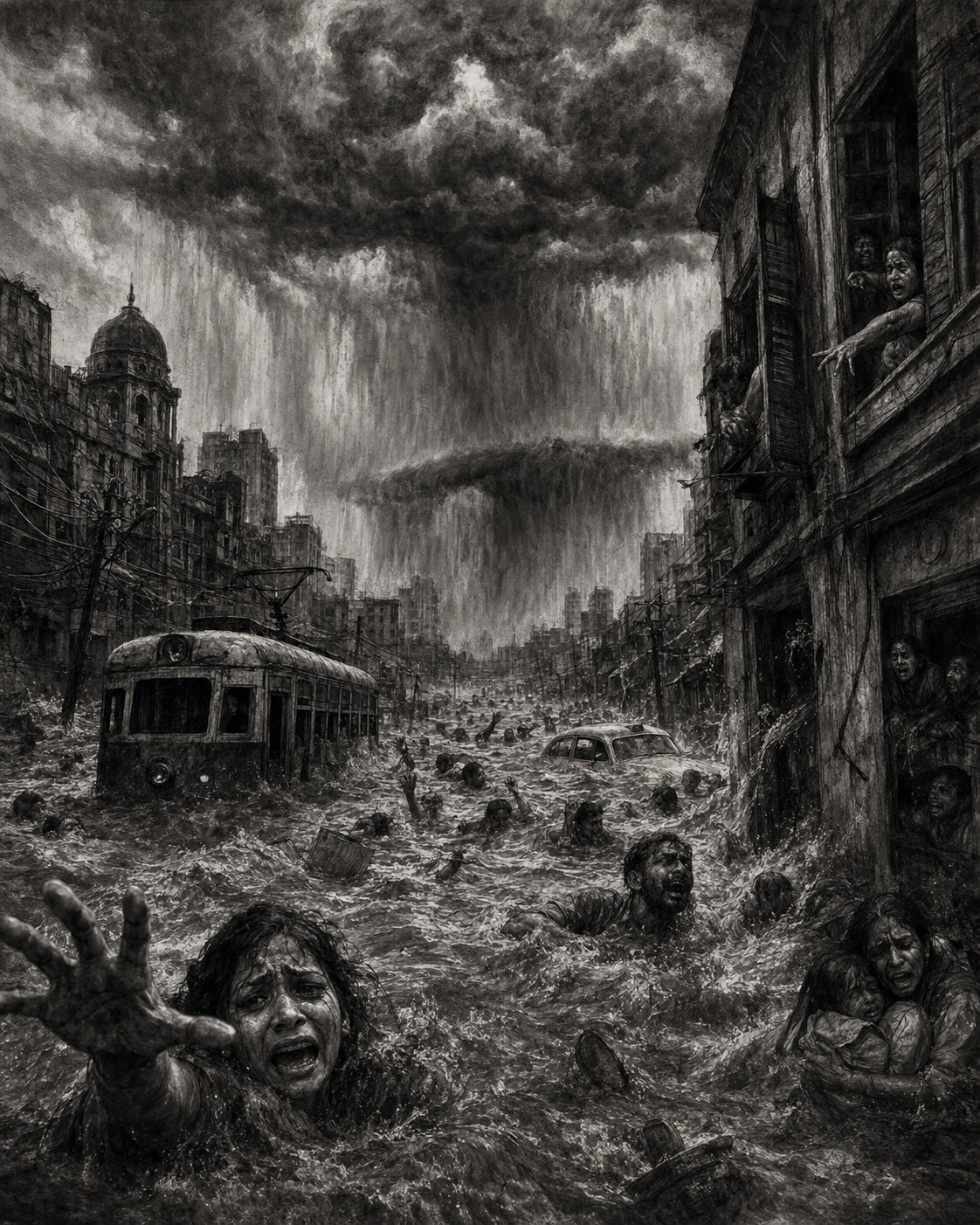
Within twenty minutes, College Street was a canal. Within forty, the buses were dead islands. Within an hour, the rain stopped so suddenly that the silence felt artificial, like a fan switched off during an exam.
Nirmal stood waist-deep in the shop and looked at the ruined books floating around him. A torn atlas opened near his hand to the Bay of Bengal. The blue ink had begun to run.
Mr. Bose sat on the counter, panting. “Stay,” he said. “No use going. Water will go down.”
Nirmal thought of Piu alone in the ground-floor flat. Their building had an old courtyard, a locked terrace, and drains that worked according to mood. He thought of the rent money in his pocket, now probably wet. He thought of his younger sister Bela, dead forty-three years, whose name came to him whenever water touched his knees.
“I have to go,” he said.
Mr. Bose stared. “Are you mad?”
“Moderately. Like all Bengalis.”
“You will drown.”
“Then you can deduct my loan.”
Mr. Bose did not laugh. That frightened Nirmal more than the water.
The street outside had lost its edges. Men moved through the brown flood with bags balanced on their heads. A woman sat on top of a taxi, holding a birdcage. The bird inside was silent. Near the university wall, a young man in office clothes clung to a lamp post and laughed in a high, exhausted voice.
Nirmal waded toward Mahatma Gandhi Road, one hand along the shopfronts, one hand pressed to his pocket. The city smelled of sewage, petrol, wet paper, frying oil, fear, and that odd mineral smell that rises from old buildings when they begin to remember they were once mud.
At the corner of Bankim Chatterjee Street, he saw the first impossible thing.
The water was not flowing downhill.
It was moving in two directions at once, half toward Bowbazar, half toward the north, meeting in the middle with a soft, muscular heave. Plastic bottles spun upright like little pilgrims. A wooden chair floated past him, stopped, turned back, and nudged his thigh.
On its seat lay a red hair ribbon.
Nirmal reached for it without knowing why.
The ribbon was old-fashioned, cotton, faded at the fold. Bela had worn one like it. Every girl in 1983 had worn one like it, he told himself. The city was full of old things. Calcutta threw nothing away. Not furniture, not grudges, not dead children.
He let it go.
By the time he reached Amherst Street, the light had turned greenish. The first floors of buildings had become thresholds to another world. People leaned from balconies, shouting names downward.
“Bappa!”
“Ma!”
“Dilip-da!”
“Who has rope?”
“Don’t open the fridge, current may come!”
A milk van lay tilted near the crossing, its white packets floating out like small dead fish. From a sweet shop came the smell of sugar syrup dissolving into drain-water. The owner stood on the counter and wept, not loudly, but with the practical misery of a man calculating loss even during apocalypse.
Nirmal’s building was a three-story relic with flaking limewash and iron balconies that had rusted into lace. The courtyard gate was open. The courtyard itself was a square brown well. Water had climbed halfway up the ground-floor windows.
“Piu!” he shouted.
From the first-floor landing, Farida Begum leaned over the railing. She was his neighbor, a retired schoolteacher with silver hair, sharp eyes, and the permanent expression of someone correcting the grammar of God.
“She went out,” Farida said.
Nirmal’s chest tightened. “Where?”
“To buy candles. Before the rain became Mahabharat. I told her not to go. Naturally she went.”
“When?”
“Before four. Maybe quarter to four.”
The water pressed against Nirmal’s waist. Their door was shut. A brass padlock hung outside.
“She locked it,” Farida said. “Good girl. Foolish, but good.”
“Did she come back?”
Farida did not answer quickly enough.
Nirmal grabbed the railing and pulled himself up the stairs. The stairwell was dark and smelled of damp concrete, kerosene, and fear-sweat. On the landing, Farida handed him a towel as if he had come from an ordinary rain.
“Breathe,” she said.
“I have to find her.”
“You will wait until water drops.”
“I waited once,” he said.
Farida’s face changed. She knew about Bela. Everyone old in the para knew some version of everyone’s tragedy. That was how Calcutta preserved history: not in archives, but in half-correct whispers over fish scales and coriander.
In 1983, during a monsoon flood, Nirmal had been thirteen. He and Bela had been sent to bring back kerosene from the shop. The water had risen fast near the lane. Bela had slipped near an uncovered drain. He had caught her hand. For three seconds. Then something under the water had struck his shin, pain had burned white, and his fingers had opened.
He had told everyone the current took her.
This was true.
It was also not the whole truth.
Farida’s servant boy, Tapan, came down from the second floor carrying a coil of clothesline. He was seventeen, thin as a matchstick, and determined to look useful.
“Kaku, I saw Piu-di near the medicine shop,” he said.
Nirmal turned. “When?”
“Before big rain. She was helping old Mukherjee-mashi cross. Then I ran.”
“Which medicine shop?”
“Near the cinema.”
The old Minerva cinema, closed for years, stood two lanes away, its walls covered in political posters and coaching center advertisements promising government jobs to a generation being boiled slowly in hope.
Nirmal took the clothesline.
Farida caught his wrist. “Nirmal, the sky is wrong.”
He looked past the balcony.
Clouds had gathered again over the city. Not ordinary storm clouds. These sat low and black, their bellies swollen, layered one upon another like bruises. The air had gone still. No crows. No horns. No human shout carried far. Only water licking walls.
“Cloudburst cannot come twice like this,” Farida whispered.
“Tell that to the cloud.”
He tied one end of the line around the stair railing and looped the other around his waist.
Farida said, “Your pocket.”
“What?”
“The money. Give it.”
He hesitated.
In that hesitation sat his entire foolish life: rent, dignity, fatherhood, masculine secrecy, the small middle-class terror that poverty must never be seen naked. Farida looked at him and understood.
“Arrey, I am not stealing your kingdom,” she snapped. “If you drown, should I pay the landlord with your corpse?”
He gave her the wet bundle. She tucked it inside her blouse without ceremony.
“Bring the girl,” she said.
Nirmal went back into the water.
The lane outside had deepened. It reached his chest now. He moved by gripping window bars and drainpipes. Twice his feet found no ground and he floated, the rope jerking at his waist. Around him household objects drifted past with terrible intimacy: a child’s slate, a pressure cooker lid, a framed wedding photograph face-down, a plastic Ganesh, a packet of sanitary napkins, someone’s school certificate sealed in a transparent folder.
The city’s privacy had dissolved. Drawers, cupboards, shame, savings, medicine strips, love letters, old bills—everything came out and floated together. In Calcutta, even disaster had no respect for personal boundaries.
At the corner, he found old Mukherjee-mashi’s walking stick wedged in a grill.
The medicine shop shutters were down. The water had reached the signboard. A man’s arm protruded from the gap beneath the shutter, fingers swollen, nails painted with mud. Nirmal looked away, then forced himself to look back. Not Piu.
He shouted her name until his throat hurt.
The second rain began with one drop.
It struck the water before him and made a dent the size of a bowl.
Then the sky opened.
There was no build-up, no polite drizzle, no consultation with the municipal drainage department. Water fell in sheets so dense he could not see his own hand. It hammered the flooded lane flat, then white, then boiling. The sound erased thought.
The rope at his waist tightened. Farida or Tapan was pulling from the building. Nirmal tried to turn back.
Then he heard Piu.
“Baba!”
Not from the lane.
From below.
He froze.
“Baba!”
The voice came through the water at his chest, clear as speech through a wall. Not loud. Close.
His legs went cold.
“Piu!” he shouted.
A face surfaced beside a floating wooden crate. Not Piu. Bela.
Thirteen years old forever, hair parted and tied with red ribbons, eyes open, mouth full of brown water.
Nirmal tried to scream, but rain filled his mouth.
The face sank. Another rose near the medicine shop shutter: a man with spectacles, lips blue, looking annoyed at the inconvenience of death. Then a woman with vermilion washed across her forehead like blood. Then a child. Then another child.
The flood was bringing up faces.
Not bodies. Faces only, surfacing where air bubbles broke, forming from water and silt and vanished again when touched by rain.
“Baba!” Piu called.
He staggered toward the cinema.
The old Minerva stood ahead, its entrance half-submerged, its torn posters flapping under the rain. Once, Nirmal had brought Piu there when it still showed afternoon films with broken seats and heroic mosquitoes. She had been seven and had asked why the hero’s mother always died. “Because otherwise the hero would have to get a job,” Nirmal had said. Piu had laughed so hard Frooti came out of her nose.
The cinema doors were open.
Inside, the lobby was flooded almost to the ceiling fan switches. Posters of dead actors peeled from the walls. The ticket counter glass had cracked. Rain fell through holes in the roof in silver columns.
“Piu!”
Something moved in the darkness near the staircase to the balcony.
He swam more than walked, the rope dragging behind him. The balcony stairs rose above the water. On the fifth step sat Piu, soaked, shivering, alive. Beside her lay Mukherjee-mashi, unconscious but breathing, her white hair plastered to her skull.
For a moment Nirmal could not move. Relief has weight. It pinned him harder than fear.
Piu saw him and began to cry, which she had not done in front of him since her mother’s funeral.
“You idiot,” he said.
“You came,” she said, as if this surprised her.
This hurt him.
He climbed the stairs and held her. She smelled of rain, antiseptic from the medicine shop, and terror. He touched her head, her shoulders, her face, checking for injury.
“The water rose,” she said. “Mashi fell. I dragged her here. The doors shut by themselves, Baba. I swear. Someone kept knocking from outside, but when I opened—”
“Later.”
“No, listen. There were people in the water. They were calling names.”
The second rain drummed harder. The flood in the lobby rose step by step.
Nirmal bent to lift Mukherjee-mashi. His back screamed. Piu helped, though her hands shook.
“We go now,” he said.
The rope pulled tight again. Then slackened.
Nirmal looked down.
The line floated loose in the lobby water, its end cleanly cut.
From the dark water below came Farida’s voice.
“Nirmal.”
He turned so sharply Mukherjee-mashi nearly slipped.
Piu whispered, “That is not Farida-mashi.”
The voice came again, patient, soaked, intimate.
“Nirmal. Leave the old woman. Bring your daughter.”
He stared at the water. A face formed there, not Farida’s now but his mother’s, dead ten years. Then Mr. Bose. Then Bela.
Bela looked up at him from the flooded lobby with her red ribbons drifting beside her face.
“Dada,” she said.
Piu gripped his arm. “Baba, what is happening?”
The water climbed another step.
Nirmal understood then, not in words but in the old animal part of the body. The first rain had flooded the city. The second had flooded what the city had kept underneath.
Every drain was a mouth. Every lane was a throat. All the names swallowed by flood, fever, negligence, poverty, bad luck, bad planning, bad memory, and the national talent for adjusting to catastrophe—they were rising. Not to explain. Not to forgive. To be counted.
“Dada,” Bela said again. “You let go.”
Piu looked at him.
Outside the cinema, the city roared. Somewhere a wall collapsed with a sound like furniture dropped by giants.
Nirmal lowered Mukherjee-mashi onto the step and sat beside her. His legs trembled.
“Yes,” he said.
Piu stared. “What?”
“I let go.”
Bela’s face remained still.
“I was scared,” Nirmal said. “The water pulled. Something hit my leg. I thought I would go too. I opened my hand.”
The confession was small. Pathetic, even. He had imagined it for forty-three years as a thunderclap, but it came out like a man admitting he had misplaced a key.
Piu said nothing.
The water rose to the step below them.
Bela lifted one wet hand. In it was the red ribbon.
“You came for her,” she said.
Nirmal did not know whether she meant Piu or herself.
The cinema groaned. A portion of the ceiling fell into the lobby, sending a wave against the stairs. Mukherjee-mashi coughed and spat water. Piu cried out.
Nirmal stood.
The balcony staircase led upward to the projection room and, beyond it, perhaps the roof. He remembered the layout from years ago: a narrow service door behind the screen, iron ladder, locked terrace. Always locked. Calcutta loved locking exits. It gave everyone a feeling of management.
“Help me,” he told Piu.
Together they hauled Mukherjee-mashi up the stairs. Behind them, the water followed with obscene calm. Faces formed and broke on its surface. Some he knew. Most he did not. Shopkeepers, clerks, children, servants, mothers, men who had gone out for bread and never returned. The drowned democracy of the city, finally equal and entirely too late.
At the balcony landing, the door to the projection room was jammed.
Nirmal slammed his shoulder into it. Pain burst down his arm. Piu joined him. On the third blow, the swollen wood gave.
The projection room smelled of rust, pigeon droppings, and old film. A square hole in the far wall opened onto the auditorium, where the empty screen hung in darkness like a wet shroud. Beside a metal cabinet was the service ladder.
At its top: a trapdoor secured with a chain and padlock.
Piu laughed once, madly. “Of course.”
Nirmal searched the room. Nothing. Old reels. Broken chair. Film cans. A rusted spanner too small for the chain.
The water entered the projection room.
Mukherjee-mashi moaned.
Piu said, “Baba.”
Nirmal looked at the padlock.
Then he remembered the rent money.
“Farida has it,” he said.
“What?”
But not all of it. He had kept the coins. Habit. His father had taught him never to give all money from the pocket at once, a principle that had probably harmed their family more than helped it. In his trouser pocket, beneath the wet lining, his fingers found the old brass key to their flat, two coins, and the small bookbinder’s knife he used for cutting thread.
He opened the knife.
The chain was thick. The padlock old.
He wedged the blade into the lock and twisted. The blade bent. His hand slipped. Blood opened across his palm, immediately diluted by rainwater dripping from the trapdoor.
Below, in the rising water, Bela watched.
“Again,” Piu said.
“I know.”
“No, you don’t. Again.”
He twisted with both hands. The blade snapped.
The padlock opened.
For one ridiculous second Nirmal felt offended by how easily the world gives way after wasting your life.
He shoved the trapdoor open. Rain struck his face. Not falling now. Pouring sideways, upward, everywhere. The roof was a shallow lake under a black sky. Beyond the cinema, Calcutta had become water with buildings sticking out of it like broken teeth.
They climbed.
Nirmal pushed Mukherjee-mashi up first, then Piu. As he lifted himself, something caught his ankle.
A hand.
Small. Cold.
He looked down through the trapdoor.
Bela stood on the ladder below him, water streaming from her hair, red ribbons bright as arterial blood.
“Dada,” she said.
His wounded hand gripped the roof edge. Piu shouted above him, “Baba!”
The city below made a long, low sound. Not thunder. Voices. Millions of them, pressed together under rain, calling from streets, shops, buses, bedrooms, kitchens, stairwells, ground-floor flats, basements, hospitals, markets, and locked rooms where water had come in like a relative with a key.
Nirmal looked at Bela.
“I’m sorry,” he said.
Her fingers tightened on his ankle.
He could kick free. He knew this with terrible clarity. He could kick, climb, shut the trapdoor, sit with his daughter in the rain, and spend whatever remained of life adding one more silence to the city’s collection.
Instead he reached down.
Piu screamed, “No!”
Nirmal caught Bela’s wrist.
For a moment she was heavy, real, a child in floodwater. He pulled. His shoulder burned. His palm split wider. The roof edge tore his ribs. He pulled as he should have pulled forty-three years before, with the selfishness of love rather than the caution of fear.
Bela rose halfway through the trapdoor.
Then she changed.
Not into a corpse. That would have been easier. She changed into water, into a column of brown rain shaped like a girl, and through her passed other hands, other faces, other names. They poured upward through the trapdoor, not attacking, not blessing, simply arriving.
Piu grabbed Nirmal by the belt and screamed at him to climb.
He fell onto the roof beside her as the projection room below filled completely. The trapdoor vomited water for a few seconds more, then stopped.
The second rain ended.
In the silence after, the whole city seemed to listen.
Dawn came slowly, gray and ashamed. From the cinema roof, Nirmal saw what no newspaper could ever properly say: neighborhoods erased to the second floor, buses nose-down in crossings, shop signs floating loose, saris tangled in tram wires, men and women standing on roofs with faces emptied by arithmetic. The dead were not visible at first. That was the cruelty. A drowned city hides its account books under the surface.
Piu sat beside him, wrapped in an old poster torn from the wall, holding Mukherjee-mashi’s head in her lap. She had not spoken since the rain stopped.
Farida arrived near noon in a rescue boat made from two doors tied to oil drums, piloted by Tapan and three men who looked surprised to be alive. She climbed onto the roof and slapped Nirmal once, not hard.
“For making me keep your wet money,” she said.
Then she hugged Piu.
Nirmal looked for the red ribbon. It lay near the trapdoor, dry.
Impossible, of course.
He picked it up.
Piu watched him. Her eyes were swollen, older.
“Who was Bela?” she asked.
This time, Nirmal told her the whole truth.
As he spoke, water dripped from the cinema cornices, from tram wires, from torn posters promising jobs, fairness, change, English fluency, instant success. Around them Calcutta steamed gently in the returning heat, already preparing, with its ancient and unforgivable talent, to continue.
When Nirmal finished, Piu took the ribbon from his hand.
She tied it around her wrist.
Below them, in the brown water covering the lobby, faces began to appear again—not rising now, not calling, only looking upward, waiting to see who would remember them when the sun came out.